
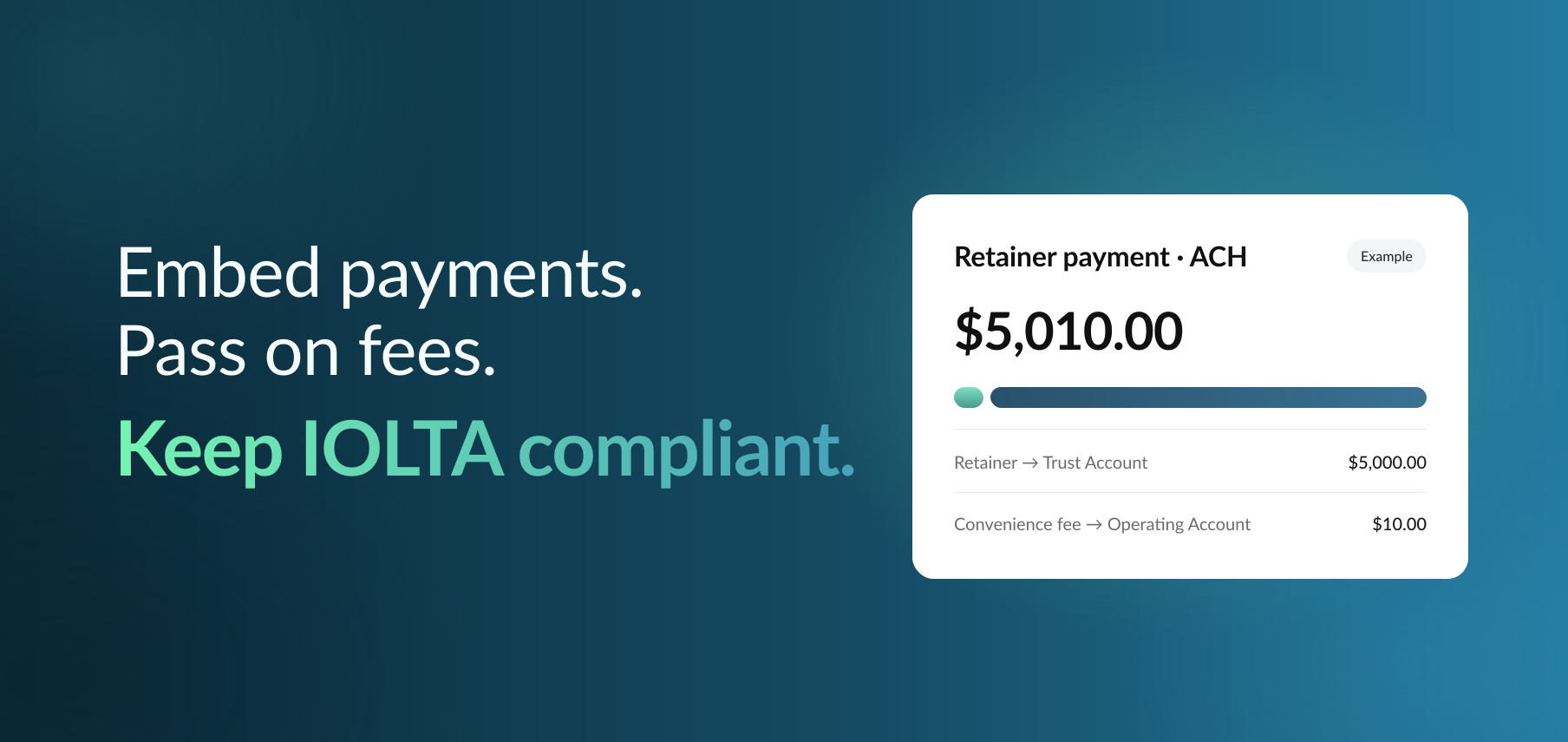
Adding payments to legal practice management software isn't hard because of the checkout form. It's hard because every dollar has to land in the right account: unearned money in trust, earned fees in operating, and nothing taken out of trust along the way. Firms ask a related question every time a client pays a retainer by card: who pays the processing fee, and can it be passed on? This guide covers both, for legal platforms building payments in and for firms running payments themselves.
Quick Takeaways
- Trust-compliant payments come down to a few mechanics: send unearned funds to trust and earned fees to operating, keep processing fees and reversals off the trust balance, and keep a clean record of every transaction.
- Practice management platforms can embed those mechanics with separate trust and operating accounts per firm, split funding, and fee billing that never touches trust.
- Convenience fees can be allowed, but only within your state bar's rules, card network surcharge rules, and state law. ACH is often the simplest choice for large retainers.
What makes a legal payment "trust-compliant"?
ABA Model Rule 1.15 requires lawyers to hold client funds separate from their own property. Legal fees and expenses paid in advance go into a client trust account and can be withdrawn only as fees are earned or expenses incurred. States adopt their own versions of the rule. For payments, it comes down to four things:
- Right account, every time: unearned retainers go to trust, while earned fees and invoices for completed work go to operating.
- No deductions from trust: a processor that nets its fees out of a retainer leaves the client's trust balance short.
- Reversals kept off trust: a chargeback or ACH return pulled from trust can use one client's money to cover another's dispute.
- A clear record: every transaction ties back to a client and matter.
Our trust account compliance evaluation guide goes deeper on each point.
Why do generic payment setups break down for law firms?
Most payment tools assume one bank account, with fees taken from each deposit. For a firm, that can mean a $5,000 retainer arrives in trust as $4,850, an earned fee lands in trust and creates commingling, or a dispute pulls money from trust. Once a practice management platform collects payments for its firms, those trust rules become product requirements.
How can legal practice management software embed trust-compliant payments?
Build the trust rules into the payment flow so firms don't have to remember them on every transaction.
Oddr, a legal tech platform that integrated Payload, described the build:
"Integrating with Payload was seamless. Their APIs are clean, intuitive, and well-supported, which made development smooth from day one." — Oddr
Here's how the trust rules map to Payload.
Give each firm separate trust and operating accounts
Each firm on your platform can have its own processing accounts, so trust and operating deposits go to different bank accounts. Firms can apply through a hosted enrollment link or an enrollment plugin embedded in your app, so you don't have to build onboarding forms or collect sensitive data yourself.
Route each payment to the right account
When one payment covers both a retainer and an earned invoice, dynamic funding can split it across accounts in a single transaction. Payload's docs list legal trust accounting as a use case: splitting a payment between an IOLTA trust account and an operating account for earned fees. Your software already knows the matter and invoice, so it can set the split automatically.
Keep processing fees off the trust deposit
On Payload's legal payments platform, processing fees never debit IOLTA accounts. The settings behind this are documented. Processing settings can bill fees monthly instead of netting them from daily funding. With gross deposits, Payload's fees documentation says monthly fees can be charged to a separate account, such as the firm's operating account. Firms can also pass all or part of the fee to the client where that's allowed (see the convenience fee section below).
Protect trust balances from reversals
Payload's legal platform includes chargeback handling designed to protect client trust balances. Disputes and bank rejects are also available through the API, so your software can show each reversal on the right matter.
Handle outbound payments in the same system
Legal money moves out as well as in. With Payload's Payout API, platforms can send settlement payouts, referral fees, co-counsel disbursements, expert witness payments, and vendor bills. Funds can be routed from operating or trust based on the payment type, without moving them by hand.
Platforms can choose a no-code, low-code, or deep API integration and add more over time. For more on the platform side, see why legal tech platforms need better payment infrastructure.
How can law firms charge convenience fees without violating IOLTA rules?
This is really two questions: is passing the fee ethical in your state, and is it allowed under card network rules and state law? Both answers have to be yes.
What ethics opinions say
Many bars allow lawyers to pass card processing fees to clients, usually with conditions. Missouri's Informal Opinion 2019-08, for example, allows it when the fee is disclosed in advance, reflects no more than the actual processing cost, has the client's informed consent, and fits the processor's terms and applicable law. It adds that if the lawyer absorbs the fee instead, the fee can't be deducted from the trust account. New York's Ethics Opinion 1050 allows a nominal up-charge over the actual fee, as long as it's reasonable and the client is told and agrees in advance. That ethics opinion doesn't override other limits, though. Since February 11, 2024, New York's credit card surcharge law caps a surcharge at what the card company charges the business and requires the total card price to be clearly posted before the client pays.
The details differ by jurisdiction, including whether a lawyer may deposit their own money into trust to cover fees. Treat these as examples, not a rule for your state, and confirm the current guidance with your state bar.
What the card networks require
Card networks have their own rules for adding fees to card payments, including which cards a fee can apply to, how much it can be, and how it must be disclosed. State laws add their own limits. Your payment provider should help you set up fees that follow these rules, so you don't have to track them yourself.
Practical options for firms
- Absorb the fee from operating: the simplest option, and it keeps trust untouched.
- Pass a permitted fee to the client: only where your bar and state allow it, with disclosure and consent, ideally in the engagement letter.
- Split the fee: cover part and pass part, within the same limits.
- Steer large retainers to ACH: bank payments usually cost less, which makes the fee question smaller.
How fee settings work in Payload
Payload lets firms pass card fees to payers or split them. Payload supports passing the full fee, part of it, or none of it, configured by payment method type. Whatever a setting is called, how a fee is classified and whether it's allowed still depend on your bar, the card networks, and state law. Platforms can offer these choices in their own settings, and firms working with Payload directly can set them up with Payload's team.
How do law firms accept ACH retainer payments into client trust accounts?
ACH suits retainers well. Bank account payments are built for large-ticket charges and payments that often can't go on a card. A typical flow:
- Request: send the client a payment request or payment page tied to the matter, by email, by text, or on your website.
- Verify: the client links their bank account with instant account verification or micro-deposits, plus optional balance checks.
- Deposit: the payment goes to the trust processing account. For recurring retainers, autopay can collect future payments automatically.
Plan for ACH returns as part of the workflow. Under Nacha rules, unauthorized consumer ACH debits generally have a 60-calendar-day extended return window measured from settlement, and other consumer remedies and warranty claims follow different timelines. That's one more reason to keep returns from hitting trust balances. Our post on what law firms should expect from a payment platform covers ACH and card tradeoffs in more detail.
What if your firm isn't on a practice management platform with payments?
Firms don't need to wait for their software to add payments. Payload's off-the-shelf tools give firms the same trust and operating setup directly:
- Payment links and pages for retainers, settlements, and consultation fees, branded with your firm's name and logo.
- Invoicing with recurring invoices, email reminders, autopay, and automatic late fees.
- A dashboard that reconciles trust and operating activity in one place, with audit-ready transaction histories, three-way reconciliation support, and reports you can export for your accountant or a bar audit.
- Payouts for co-counsel, referral fees, and vendor bills.
Perigon Legal, a law firm that uses Payload's dashboard, put it this way:
"Payload's seamless, single-step payment link makes it incredibly easy to capture payments, and we are streamlining our legal invoicing with their platform. Partnering with Payload has been a fantastic decision!" — Perigon Legal
What should legal tech platforms look for in an embedded payments partner?
- Separate trust and operating accounts per firm, with embeddable onboarding.
- Trust and operating splits in a single transaction.
- Fees billed outside trust, with pass or split options that follow network rules.
- Reversals kept away from trust balances.
- Outbound payouts on the same infrastructure.
- Security credentials such as SOC 2 Type II and PCI DSS Level 1.
FAQ
Can a law firm accept credit cards for retainers?
Generally, yes. The payment needs to land in trust in full, with processing fees paid from operating or passed to the client where allowed. Rules vary by state, so confirm the details with your state bar.
Can a convenience fee be deducted from the trust account?
It shouldn't be. Processing charges can't reduce the client money that has to stay in trust, which is why collecting fees from the firm's operating account is the safer setup. Ethics opinions such as Missouri's say fees the lawyer absorbs must not come out of trust, and a fee passed to the client is charged on top of the payment, so the full retainer still reaches trust. Some states let lawyers keep a small amount of their own money in trust for bank charges, but don't assume that covers card processing fees. Check your state bar's rules.
Does a practice management platform need to become a payment facilitator to offer payments?
Not necessarily. With an embedded payments provider, the platform can offer onboarding, payments, and payouts inside its product while the provider handles KYC, verification, and processing.
Is Payload the same as Payload CMS?
No. Payload (payload.com) is an embedded payments company. Payload CMS is an unrelated content management system.