
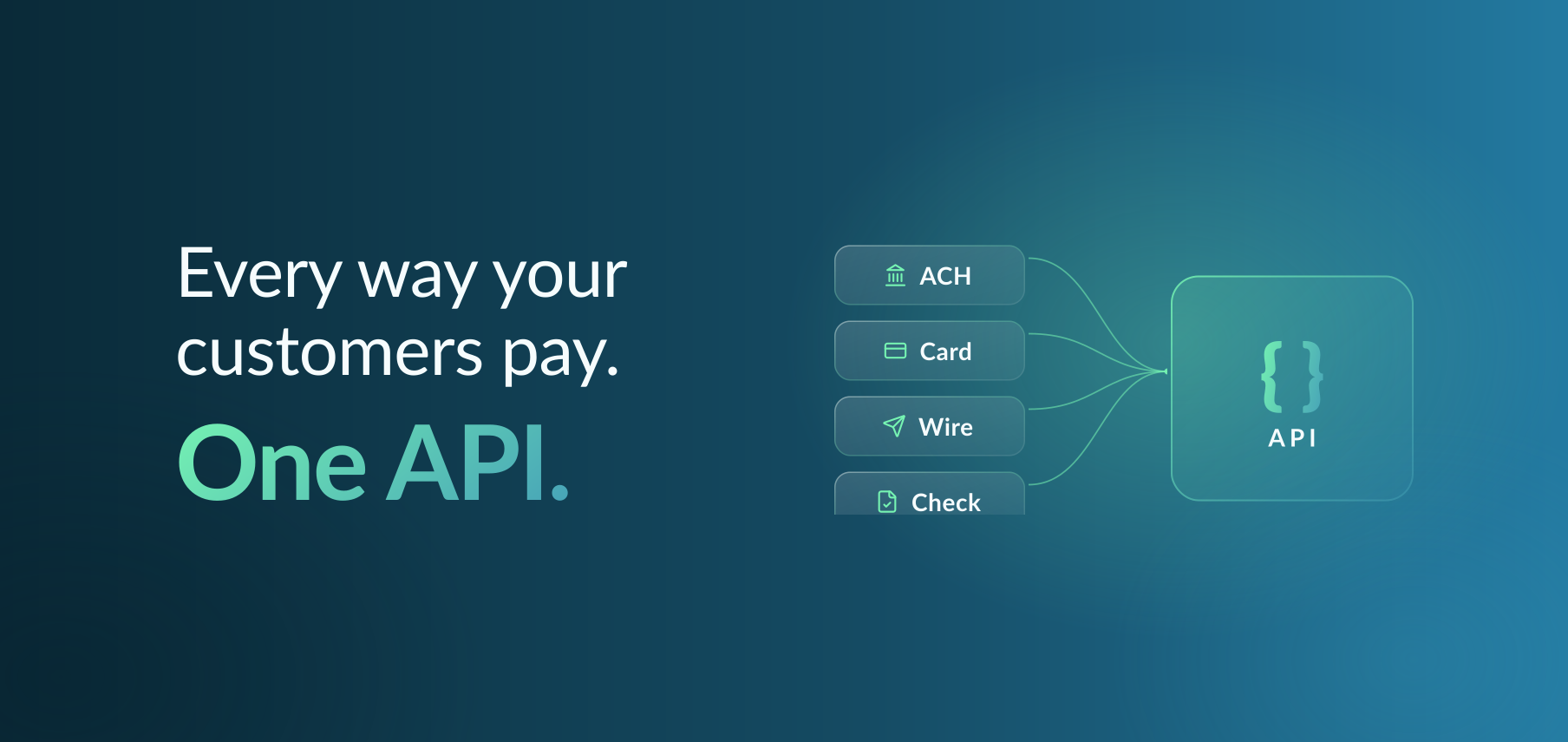
Vertical SaaS customers rarely get paid one way. A property manager collects rent by ACH and card, a title company receives five-figure deposits, and a construction firm still gets paper checks while it pays subcontractors. If your platform only supports cards, that money moves somewhere else, along with the revenue that comes with it. Teams often stitch together a card processor, an ACH provider, a check lockbox, and a payout vendor, each with its own onboarding, ledger, and reconciliation. The implementation problem is getting those rails onto one API.
Quick Takeaways
- One API can cover cards, wallets, ACH, digital wires, checks, and payouts, so you maintain one integration instead of several.
Start with onboarding, fees and funding, and reconciliation. Each business on your platform needs a verified processing account.
Add rails as you need them, then add payouts in the same integration, including instant RTP when speed matters.
Why do vertical SaaS platforms need more than one payment rail?
Card-only checkout struggles with large invoices, earnest money, rent, retainers, and anything sent to a vendor. Payload's documentation notes that bank payments suit "large-ticket charges, payouts and transfers, instant payments, and transactions that typically can't be put on credit." Supporting several rails lets customers run their whole payment workflow inside your product instead of falling back to manual checks and bank portals.
What does "one API" mean in practice?
One integration, one data model, and one ledger for every rail, with the rail chosen per transaction. With Payload, cards, bank accounts, and synthetic (virtual balance) accounts are payment method types on one object, and a transaction references the method you choose. You change the method and timing fields rather than calling a different system. Platforms can choose how much to build:
Off-the-shelf: hosted payment links, a branded payment portal, and ready-made UI components.
Modular APIs: the REST API combined with embeddable components inside your product.
Backend-only: keep your own front end and use Payload for processing, split funding, payouts, and webhooks.
Jameson Sotheby's International Realty described that shift:
"We partnered with Payload to unify our payment environment for Earnest Money Deposits, commission payments, as well as processing expenses from agents and third party vendors. It has simplified our workflow while expanding our offerings."
— Jameson Sotheby's
How to add multi-rail payments to your platform
Onboard each merchant, set fees and funding, and automate reconciliation so every rail shares one ledger.
Onboard your merchants
Each business that accepts payments on your platform needs a processing account. Payload offers three ways to create one:
Enrollment link: a hosted application you can send by email or text, with no onboarding UI to build.
Enrollment plugin: an embedded onboarding flow (modal or inline) inside your app.
Accounts API: for advanced teams that need full programmatic control.
The hosted options handle terms, consent, and attestations and keep sensitive data off your servers. Payload provides KYC/KYB, AML and watchlist screening, and ongoing monitoring, with tiered verification matched to your risk model. Payers and payees can be simpler customer accounts that don't need KYC for basic use.
Set fees and funding
Decide who pays and how your platform earns. You can set flat, percentage, tiered, or hybrid fees per method, account, or transaction; absorb them, pass them to the payer, or split them; and collect them from settlement, on an invoice, or out of a payout. Revenue sharing is built in.
On the funding side, you can set funding timing from instant and same-day to T+1 or custom schedules, and split a single payment across multiple accounts, such as a management fee to the manager and the rest to the owner.
Automate reconciliation
Payload's ledger links payments to related settlement deposits, refunds, and reversals, and settlement packaging (netted, gross, or itemized) is configurable. Add custom attributes such as property, project, or invoice IDs, and custom descriptors so bank statement lines are easy to match. Use webhooks for bank rejects and disputes, and report queries to build reports by customer, product, or period.
Add the rails your customers need
Cards and digital wallets
Add card acceptance for Visa, Mastercard, Amex, and Discover, plus Apple Pay and Google Pay. Card details are tokenized, so your systems only store a payment method ID. CVV and AVS checks help confirm the cardholder. If your customers want to pass card costs on, convenience fees are supported.
ACH and pay by bank
Bank payments are usually the cheapest way to collect rent, dues, invoices, and other recurring or large payments. Payload supports ACH debits with next-day clearing by default and same-day clearing where it's available. Nacha's Same Day ACH service is designed to send and receive ACH debit and credit payments within hours on the same business day.
Let payers link accounts instantly through Plaid, or use Payload's built-in verification.
Turn on balance checks to reduce failed payments from insufficient funds.
Store the bank account once and reuse it for autopay and billing schedules.
Digital wires for high-value payments
For large, time-sensitive payments such as closing costs, legal settlements, or project deposits, Payload offers digital wires. These are bank account payments with same-day posting and rapid funding, so funds are available within hours instead of days. Digital wire processing with rapid funding requires account approval, is US and USD only, and a transaction created after 2:00 PM ET posts at 8:00 AM ET the next business day. The docs note they are most cost-effective for transactions over $5,000 to $10,000.
Paper checks
Many verticals still receive checks. Under the Federal Reserve's Check 21 framework, banks can process check information electronically instead of moving the original paper item. Payload supports two methods of check processing:
Check21: the payer or your customer uploads images of the front and back of the check, and OCR extracts the details.
Check conversion: record checks received at a staffed location or by mail as electronic transactions (up to $25,000, and not for certified checks). Payload's docs note that returns can occur weeks after the initial deposit.
Payouts
Use the Payout API to send vendor payments, owner distributions, commissions, and refunds to bank accounts. Recipients can enroll through a hosted link, an embedded form, or your backend. Speed options include:
Standard bank payouts: Payload's support docs say recipients can expect funds the following business day.
Instant payouts over RTP: funds arrive within seconds, including weekends and holidays, as The Clearing House describes the RTP network. Instant payouts can use a prefunded synthetic account and typically cost more than standard bank transfers.
Wire and virtual card payouts: also listed among Payload's payout methods for flows that need them.
Angie Reynolds of Uptown Rental Properties, which pays vendors through Payload's Rent Manager integration, described the change:
We definitely enjoy using Payload through RentManager for vendor payouts. We were looking for a better vendor payment option and made the switch last year. We love how vendors receive funds digitally next day and are notified of payments in real time.
— Angie Reynolds, Uptown Rental Properties
How do you choose the right rail for each payment?
Match the rail to the payment's size, urgency, and risk of being reversed.
Cards and wallets: fastest, most familiar checkout, at a higher cost, with possible chargebacks.
ACH (next day and same day): lower cost for recurring and large payments. The sending bank approves or rejects a processed transfer within 2-3 business days, for reasons such as insufficient funds or a closed account.
Digital wires: same-day posting and rapid funding for high-value payments, with higher fees, required approval, and a 2:00 PM ET cutoff.
Check21 and check conversion: digitize payers who still write checks, with a $25,000 limit on check conversion.
Standard bank payouts: the lowest-cost way to pay vendors and owners, with funds expected the following business day.
Instant payouts over RTP: funds in seconds, around the clock, at a higher fee; can use a prefunded balance.
Let payers choose, and steer them with pricing, such as passing card fees to the payer.
What this looks like across verticals
The same building blocks map to very different workflows:
Property management: collect rent by ACH, card, or check, split payments between owner and manager, and hold per-unit security deposits.
Construction: collect progress payments and project deposits, including by digital wire, and pay subcontractors after a draw or milestone.
Senior living: run recurring ACH billing with proration for mid-month changes, even when several family members share the bill.
Real estate: collect earnest money deposits online instead of by check, then send agent commissions and closing disbursements from the same integration.
Legal: collect retainers and invoices by card or ACH, route funds to the right trust or operating account, and keep processing fees from ever debiting IOLTA accounts.
FAQ
How do returns and disputes differ by rail?
Payload documents card chargebacks and disputed bank transactions, with dispute management APIs or a full-service dispute team. Under Nacha rules, an unauthorized debit to a consumer account can be returned through the opening of business on the banking day following the 60th calendar day after the original entry's settlement date.
Are digital wires the same as a traditional bank wire?
Payload's documented incoming product is digital wires, not a traditional inbound Fedwire. Wire is also listed as a payout method.
Is Payload secure enough for regulated industries?
Payload is SOC 2 Type II and PCI DSS Level 1, and it handles KYC, AML, and fraud prevention. PCI DSS sets technical and operational requirements to protect payment account data.
Is Payload the same as Payload CMS?
No. Payload (payload.com) is a payments company. Payload CMS is an unrelated content management system.
Conclusion
If you already have card acceptance, add ACH next for rent, invoices, dues, retainers, and other recurring or large transfers. Then add payouts so vendor, owner, and commission payments can leave the platform the same way collections come in. Bring in checks or digital wires when customers still send paper or need same-day funding for high-value deposits. Prioritize the rail that unblocks the most volume, then add the next one without standing up a new integration.